
Brochure
Download our document to see specific data of the service and how we work.
Let’s Start Work
Together
Please feel free to contact us. We will get back to you with 1-2 business days. Or just call us now.
Application
The Flexible Choke & Kill Hose, designed to API 16C specifications, is a crucial component within the choke and kill system, serving as an integral part of both surface and subsea blowout prevention equipment. Its primary functions include:
Alternative Fluid Pumping: When conventional circulation through the drill string isn’t feasible, this hose enables the pumping of fluids into the well. This capability is essential during various drilling operations, especially when maintaining well control.
Back Pressure Application: In the event of a kick (an influx of formation fluid into the wellbore), the choke line and manifold provide a means to apply back pressure on the formation. This back pressure helps control the flow of fluids, mitigating the risk of a blowout and maintaining well integrity.
Sour Service Compatibility: The hose is designed to withstand the harsh conditions of sour service environments, where the presence of hydrogen sulfide (H2S) gas necessitates specialized equipment capable of withstanding corrosion and other detrimental effects.
Standard
the Flexible Choke & Kill Hose conforms to the stringent requirements outlined in API Spec 16C. This standard sets forth the technical specifications for choke and kill systems, ensuring they meet industry standards for safety, reliability, and performance. Adhering to API Spec 16C guarantees that the hose is designed, manufactured, tested, and certified to withstand the demanding conditions encountered in drilling operations.
Hose Structure
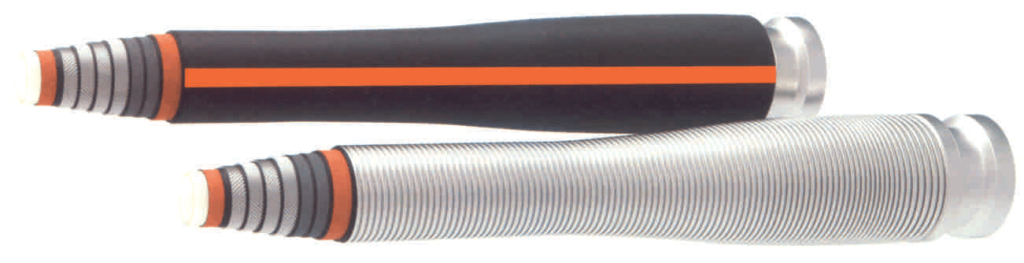
Inner Carcass: The hose’s inner carcass consists of a stainless steel framework, providing structural integrity and resistance to corrosion.
Internal Tube: Utilizing a specialized polymer engineering plastic as the inner sealing tube ensures optimal performance in sealing and fluid conveyance within the hose.
Internal Rubber Liner: The inner sealing elastomer, made from Hydrogenated Nitrile Butadiene Rubber (HNBR), offers superior resistance to fluids containing hydrogen sulfide (H2S), along with oil resistance, corrosion resistance, high temperature tolerance, and gas permeation resistance.
Breaker Layer and External Protection Layer: High-tension textile fabric layers serve as breaker and external protection, enhancing durability and safeguarding against external impacts and abrasions.
Reinforcement for Major Pressure Withstand: High-strength steel cables reinforce the hose, enabling it to withstand significant pressure loads encountered during drilling operations.
Fire Shield Layer: Incorporating a glass fiber cloth as a fire shield layer provides added protection against fire hazards, ensuring the hose’s integrity and safety in high-temperature environments.
Cover: The hose is enveloped in Neoprene rubber-based cover layers, engineered for fire resistance, wear resistance, oil resistance, ozone & aging resistance, UV resistance, and now, marine environment suitability. This modification ensures the hose can withstand the challenging conditions encountered in critical marine environments, maintaining its performance and longevity even in harsh offshore conditions.
More Detail
Verification Test: The hose has successfully passed the verification test specified in Clause B12 of API 16C, ensuring its compliance with industry standards for safety and performance.
Heat Trace Cable Assembly: As per functional requirements, the hose can be equipped with a heat trace cable, providing the capability to maintain fluid viscosity and prevent freezing in cold environments.
External Protection Layer Options: Various options for the external protection layer are available based on operational needs or recommendations. These options include stainless steel armor outer wrap, embedded stainless steel wire in the cover, or polyethylene spiral guard, each offering enhanced protection against abrasion, impact, and environmental hazards.
Metal Connectors: The hose’s metal connectors meet the requirements of NACE MR0175 / ISO 15156, ensuring compatibility with corrosive environments encountered in oil and gas operations.
Working Temperature Range: The hose is designed to operate within Class III temperature range, from -25℃ to +121 ℃, enabling its use in a wide range of environmental conditions.
Flexibility Specification Level (FSL): The hose is rated at FSL3, indicating a high level of flexibility, allowing for easy installation and maneuverability in various drilling applications.
Maximum Length: The maximum length of the hose is 70 meters, providing sufficient reach for a wide range of drilling scenarios.
Length Tolerance: Length tolerance is specified based on hose length. For lengths up to 4 meters, tolerance is ± 64 mm, while for lengths longer than 6.4 meters, tolerance is ± 1%.
Minimum Bending Radius (MBR) Measurement Basis**: The minimum bending radius (MBR) is measured from the centerline of each hose, ensuring compliance with bending requirements and preventing damage during installation and operation.